What’s wrong with this picture?

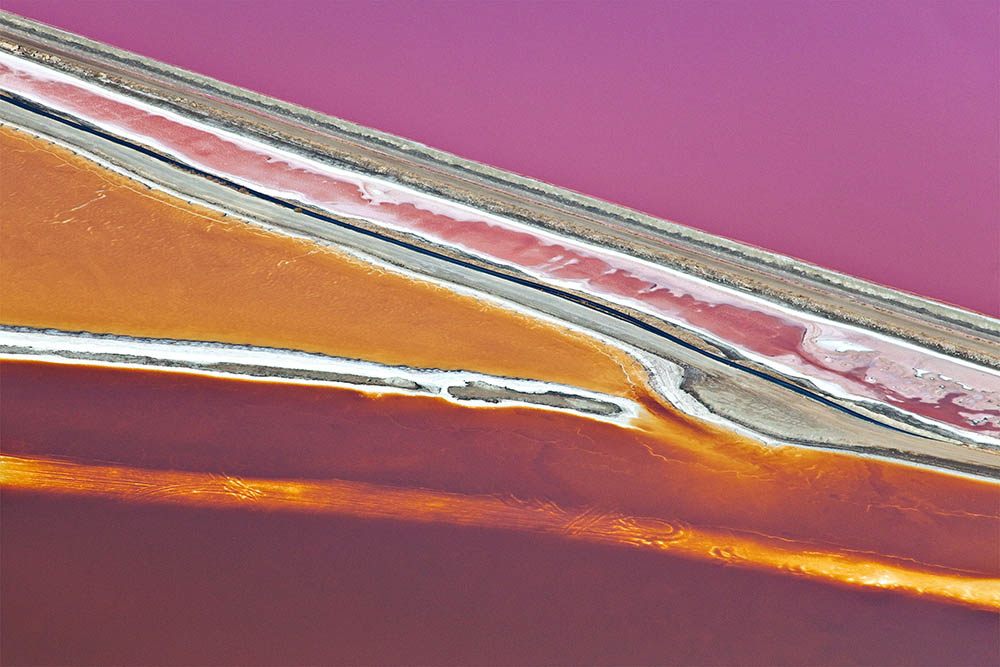
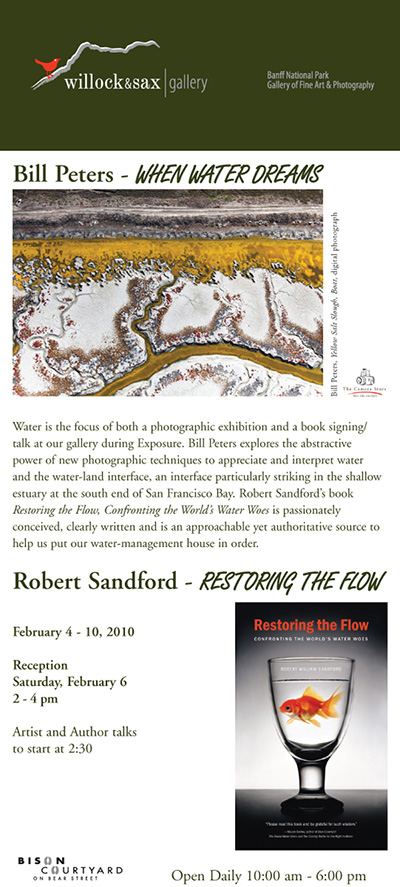
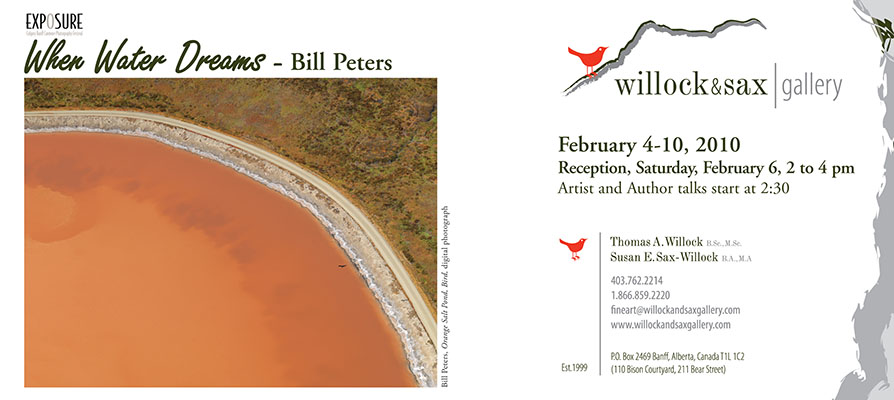
Some viewers of my images from South Sand Francisco Bay have assumed the strong colours are water pollution. When these viewers discovered that wasn’t the case, I sensed some disappointment. Perhaps their assumption was conditioned by Ed Burtynsky’s images presented by the Whyte Museum in 2009, where one especially iconic image showed water colourfully stained by nickel mining residues.
The colors in my SF Bay images are the result of microorganisms, brine shrimp for the yellows, oranges, reds and magentas and algae for the greens and some yellows. The brine shrimp change colour depending upon the salinity of the water in the salt sloughs and evaporation ponds. When the water completely evaporates, the shrimp dry out and lose their colour. (Hmmm – do we get a helping of dried brine shrimp when we consume sea salt?)

Rather than pollution, the Bay images are coloured by billions of apparently happy, thriving brine shrimp plus algae. So what’s wrong with this picture?
There are two things wrong. First it’s a monoculture. That means the salt ponds are designed to exclude all forms of life except those that, Caghill, the company harvesting the salt can put up with. Second, over 80% of the original tidal wetlands, which once lined the shores of San Francisco Bay, have been eliminated by human developments like the extensive salt pond construction.
Of course we humans depend upon monocultures – think of Alberta’s extensive wheat fields – for our existence. Monoculture agriculture is one of the innovations that lead to the growth of civilization in the ancient world and sustains our world’s burgeoning population today. It becomes a problem when it eliminates so many habitats that species become endangered or extinct and the biodiversity of our world is threatened.
The San Francisco Bay shores are an important habitat for numerous species including many varieties of migratory birds. The dangers of the human monoculture, all seven million people who surround the Bay and their related developments, have been recognized. Environmental groups and governments have been working toward restoring some of the wetlands for decades. Today the largest wetland restoration project in the western US is underway. You can find out more at the South Bay Salt Pond Restoration website.
The salt pond images are thus symbolic of our modern dilemma – finding the balance between drawing on our planet’s resources and maintaining a healthy, vibrant earth that can sustain what we draw.
I did not set out to create my images with a good/bad agenda. If anything my agenda was to be as unbiased as possible. However in discussion with viewers who assumed an agenda, I was sharply confronted with the question, “Should fine art images be judged by the degree to which they seek out the good or the bad?” I found Joerg Colberg’s comments on this dilemma enlightening: “Uprooted form the real . . .”
“What’s the point of photography when you basically demand to see a certain outcome before the photographer gets to work? . . . Whether we like it or not our world has become considerably more complex over the past fifty years, and photographers adapting to that complexity – instead of striking simple/obvious poses – is one of the many consequences of this development. Ultimately, we all can only gain from this expanded breadth of photography, because it gives us more space to explore things, and to see them from more angles than just two (“good” versus “bad”).”
To be fair to Ed Burtynsky, I am not saying he seeks out bad things. He seeks big, impactful things and leaves the meaning to the viewer. I respect his position when he says: “I search for subjects that are rich in detail and scale yet open in their meaning.”

When Water Dreams

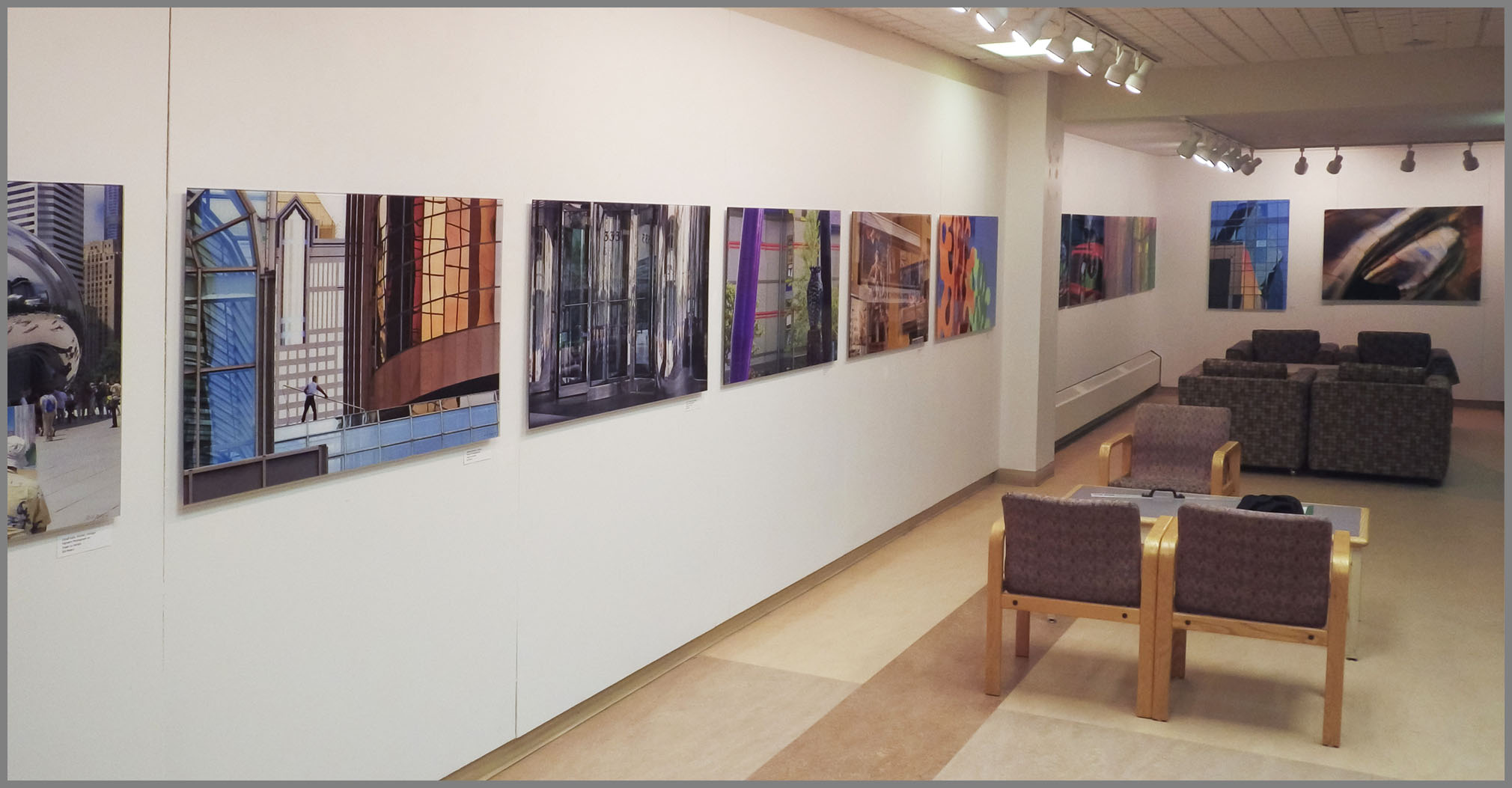
I’m delighted to invite you to the Willock & Sax Gallery in Banff for the opening of When Water Dreams. The opening event is from 2 to 4 pm on Saturday, February 6, 2010. I’m honoured to share it with Robert Sandford, who is introducing his important book called Restoring the Flow, Confronting the World’s Water Woes.

This is a great opportunity to make a winter visit to Banff, either for the afternoon or for a day or two. Willock & Sax Gallery has special discount arrangements with Juniper Hotel and Bistro and Bow View Lodge. Follow this link to book a room and take advantage of the savings: http://www.willockandsaxgallery.com/banff.htm

This show opening and book launch is part of EXPOSURE – the Calgary, Banff, Canmore Photography Festival.

48170-peters-sandford-invites-3-2s

48170-peters-sandford-invites-3-1s

Willock & Sax Gallery

wsjuly07c1

How do you purchase one of my images? It’s easy. You simply dial 1 866 859 2220 and ask for Susan.

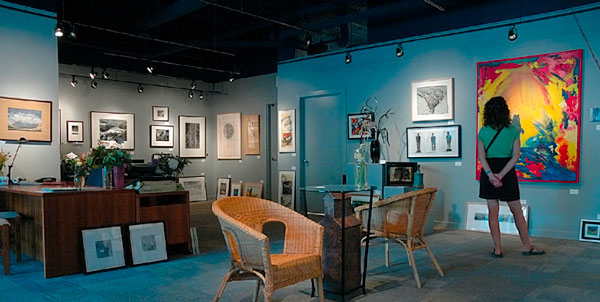
Susan Sax-Willock and Thomas Willock are the founders and owners of the Willock and Sax Gallery and they are my representatives. First opened in Waterton and now located in Banff, Alberta, their gallery is dedicated to their vision of presenting the work of a very high quality cross section of Canadian fine artists. Susan brings a background as an artist, arts scholar and arts administrator. Tom is a zoologist with an intense feeling for the earth and environment, the former Director of a major museum and a delightfully talented interpreter of the western landscape with his black and white silver prints; the ones centre-left in the image above. In my own collection I have Tom’s “Lenticular Clouds: Red Rock Canyon Road, Waterton Lakes National Park, 1983,” an image I find particularly moving.

If you travel to Banff from time to time, be sure to check the Willock & Sax website for events at the Gallery and Banff activities. Better yet, ask Susan to put you on their e-mail list. Just call her at the number above or  click here.

“When the City” Featured in Camera Store Newsletter

window-washer-calgary-c-bill-peters
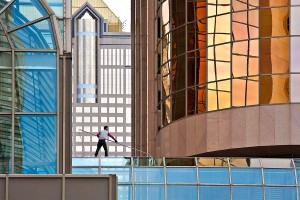
This months newsletter from The Camera Store features a number of my images and talks a bit about my working tools and methods. If you haven’t subscribed to The Camera Store’s Newsletter yet – click here.

Does Art Have Laws?

psychology-today-cover-clip0041

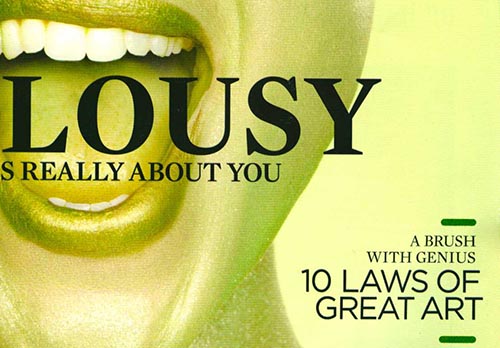
Jonah  Lehrer writes a fascinating article in the July, 2009 Psychology Today about what we are leaning about human vision and about how our brain interprets that information. Unfortunately the Psychology Today headline writer calls the ideas that Lehrer teases out “laws” on the cover. This butchers the scientific meaning of “law” and is a LOUSY thing to do. Nowhere in Lehrer’s article, titled “Unlocking the Mysteries of the Artistic Mind,” does he talk about “laws”. Instead he identifies ten perceptual principles of great art. Here are a couple of them; you will have to buy the magazine to get the rest:

“BALANCE: Successful art makes use of its entire representational space, and spreads its information across the entire canvas.

ISOLATION: Sometimes less in more. By reducing reality to its most essential features – think a Matisse that is all bright color and sharp silhouettes – artists amplify the sensory signals we normally search for.”

Will understanding the principles lead directly to you or I making great art? That is a LOUSY idea, something Lehrer acknowledges when he quotes V. S. Ramachandran, the UC San Diego scientist who had done many of the studies that form the basis of his article as saying, “Anybody can learn these visual rules, but you still need talent and training in order to turn them in to fine art.”

psych-today-aug-09-cover11Is knowing the rules a good idea? Sure. Knowing these and much more equips the artist, and the art critic, with a more capable tool kit. Still knowing the rules only gets one so far. It’s the difference between knowing the notes on the piano and being able to make great music. As I write this I think of all those who have struggled to learn the zone system only to wind up with a closet full of technically perfect but emotionally dead negatives.
Whats more, the rules of art are mainly derived a posteriori. That is we or society first identifies a work as great art, then we go seeking information on why we respond to say, the Mona Lisa, the way we do. They give us no information on how to set out to make great art.

Art is fundamentally an emotional quest. Ramachandran, with his brain imaging, reveals a neuroasethetic and gives some glimpses of why art works. The question remains open, “What drives some of us to make emotionally expressive art?”

BTW – Art is the product of our decisions. In this context I’m enjoying reading Lehrer’s recent book, “How We Decide.”

David Campion and Sandra Shields


campion-11

I get excited when I see something in an entirely new way. I get almost as excited (and a little envious) when someone shows me something through new eyes – when they grab my viewpoint and shift it.

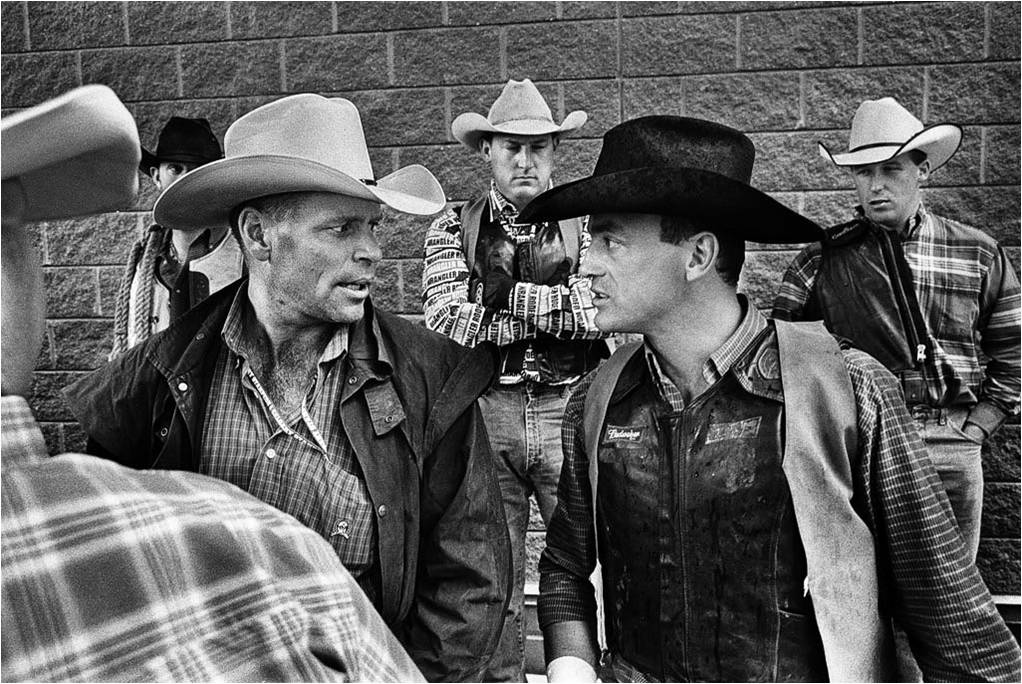
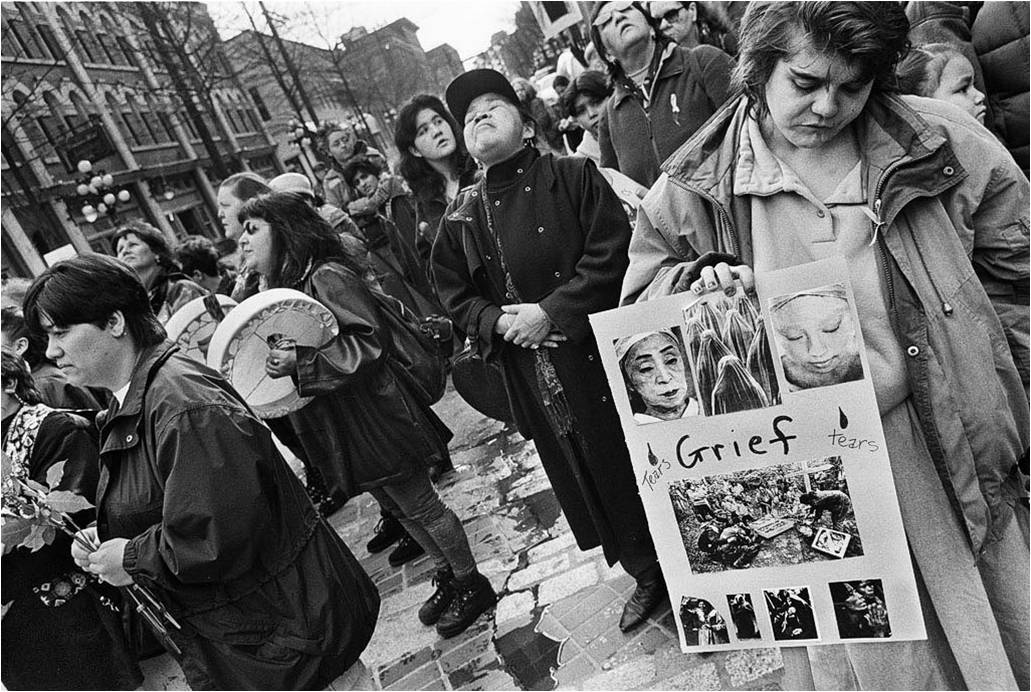
After reading David Campion’s text and reading Sandra Shields’ words, I’ll never look at the Calgary Stampede the same way again. Sandra’s article and David’s images, titled Cowboy Wild in the July 2009 issue of SWERVE Magazine combine to create an amazing piece of cultural anthropology – dissecting the mythic cowboy and the reality behind the legends that fuel Calgary’s annual festival. Unfortunately the web link to SWERVE only takes you to Shield’s text. For the images you’ll have to visit davidcampion.ca. Happily Shields’ words can stand entirely on their own as can Campion’s images. Together they have a chemistry where one plus one equals more than two.The images of Cowboy Wild were the subject of a major exhibition at the Art Gallery of Calgary during the fall and winter of 2008. Seeing the SWERVE article I was pleased by how well David’s images held up on the thin newsprint pages – even after seeing them at 20″x30″ in the exhibition.

SWERVE’s Editor-in-Chief, Shelley Youngblut, has taken a typical “what’s-on-in-town” newspaper supplement and injected a series of telling and reflective articles that sit at the junction among finely crafted literature, social commentary, fine art photography and documentary photography. In an age when thoughtful publications seem to be rarer and rarer – especially coming from a popular newspaper press, to see where Youngblut is taking SWERVE is an encouraging delight. It is worth picking up the Friday Calgary Herald just to get SWERVE – though this summer only July and August issues are being produced.

campion-21

Both Sandra and David have an ease about them that makes everyone around them comfortable. This is so evident in the photography and the writing. David’s images speak with great force – at the same time they are not forced. The same can be said of Sandra’s words, words that speak with a truth and essence of people places and events that perfectly compliment David’s images. They make us look and think about familiar things in new ways and compell us to open our eyes to parts of society that, perhaps subconsciously, we didn’t want to see. More about Sandra Shields’ writing and the Shields/Campion collaboration is at fieldnotes.ca.